
Our principles and frameworks
Vulnerability comes from systems, not from people.
Three things shape all our work: one core approach and two linked frameworks.
Our core approach. Vulnerability is not a flaw in a person. It comes from the circumstance a person is in and the systems around them.
We call this an environmental model of vulnerability.
We then use Vulnerability Manager’s ‘Before, During, After’ and ‘Empower, Support, Protect’ (BDA ESP ©) frameworks below to help us manage systems.
Before, During, After (BDA)
Framework one: when to act. Every action sits in one of three stages. Plan before, respond during and learn after.
Empower, Support, Protect (ESP)
Framework two: how to act. It names three kinds of action. Give choices, give help and reduce risk.
Contents
Our core approach
An environmental model of vulnerability
We build the systems. We are accountable for them.
Vulnerability is not a flaw in a person. It comes from the circumstance a person is in and the systems around them.
We argue that systems cause most of the vulnerable circumstances people experience. People and organisations create those systems.
A form, a deadline, a script, a price, a building. Each one is a choice. Each choice can put a person more at risk of harm or disadvantage.
So vulnerability is a by-product of how we choose to build our environments. We made the choices, so we are accountable for the results.
This is why we say “a person in a vulnerable circumstance”. We do not say “a vulnerable person”.
The four types of vulnerability
Vulnerability is harm or disadvantage.
We use four types of vulnerability. They give teams a shared way to talk about how vulnerability shows up. They are the starting point for all our training.
Each type comes from two questions:
What is the risk? Harm or disadvantage.
What is it measured against? Other people, or a set standard.
Harm means damage is done to the person. Disadvantage means a worse result, or a harder way to get the same result. No damage has to be done.
Type 1. Harm, compared with others
A process is more likely to harm this person than other people. Or more likely than others in the same situation.
Type 2. Harm, against a set standard
A process harms the person, judged against a set standard. It does not matter how anyone else is affected.
Type 3. Disadvantage, compared with others
The person gets a worse result, or a harder way to the same result, than others do. For example, a step-free route exists, but it is twice as long.
Type 4. Disadvantage, against a set standard
The result, or the way to it, falls below a set standard. It does not matter how anyone else is affected.
Why the type matters
The type tells you what to fix.
Types 1 and 3: close the gap between people.
Types 2 and 4: make the process itself better. Treating everyone the same will not fix it.
A process that treats everyone badly shows no gap between people. That does not mean there is no problem. A set standard shows it.
In our view, most published definitions look only at Type 1. The four types help you see the people those definitions miss.
Where a law or regulator sets its own definition, we follow it. The four types still apply underneath it.
Fair support is built in
If systems cause most vulnerability, the fix belongs in the system.
To treat people fairly, build their needs into the way you work with everyone.
Do not rely on separate, bespoke fixes for individuals, made after harm appears. Those should be the exception.
Support has three levels. Start with the first.
Universal. Built in for everyone. Examples are plain language, more than one way to make contact, and flexible timing.
Targeted. Extra support for needs the universal level cannot reach. A British Sign Language interpreter is one example.
Individual. Support shaped around one person’s circumstance, case by case.
Each level sits on top of the one before. It does not replace it.
Legal definitions and self-identification
Laws and regulators define vulnerability in set ways. The Financial Conduct Authority’s guidance on vulnerable customers is one example.
People also describe themselves as vulnerable. That is their right.
We accept both. We build both into our work.
When a law or regulator sets a definition, we work to it.
When a person describes themselves as vulnerable, we respect their words.
But neither is our core view of what vulnerability is.
At its core, vulnerability is a by-product of how we choose to build our environments. That includes environments where we aim to be fair.
Why this works for your organisation
Building support in is fairer. We argue it is also more effective and more efficient.
This is why our training, advice and audits start with your systems.
Fix once, help many. One change to a process helps everyone who uses it. A bespoke fix helps one person, once.
Reach people who never tell you. Built-in support does not depend on a person telling you about their circumstance. It is there for everyone.
Take pressure off your staff. Staff do not have to spot and solve every case alone. The system does more of the work.
Avoid a maze of special cases. Ten groups and twenty processes would need 200 separate pathways. No organisation can keep that up.
Stay ahead of the rules. The law already asks service providers to plan ahead for disabled people. Building support in helps you do that.
Be honest about cost. Building support in can cost more at the start. We argue that exclusion costs more over time. It brings repeated harm, lost trust and regulatory risk.
Two linked frameworks
We use two linked frameworks to help people in vulnerable circumstances. That means a time when a person is more at risk of harm or disadvantage.
Before, During, After (BDA) shows when to act. Empower, Support, Protect (ESP) shows how to act.
Each is a framework in its own right. They work best together.
Together we call them the BDA ESP framework ©.
Plan before, respond during and learn after. At each stage, give choices, help the person you’re working with and reduce risk.
Before, During, After was first used in 2012. The two frameworks put our core approach into practice in all our work.
Framework one: when to act
Before, During, After (BDA) is the time framework. Every action sits in one of three stages.
Before. Prepare and prevent. What systems, training and plans are in place?
During. Respond. What do we do? What are our options?
After. Learn and improve. What does the organisation learn, change or do?
Framework two: how to act
Empower, Support, Protect is the action framework. For short, we call it ESP. It names three kinds of action.
Empower. Give or have choices. Offer more than one way to take part, pause or stop. Ask what the person needs.
Support. Give help. Use your own time, staff and resources to help.
Protect. Reduce options and risk. Limit or remove an option that could cause harm. For example, block a payment that could cause harm.
Each alone is not enough.
Protection doesn’t support someone’s agency through choice.
Choices can’t always protect us.
Choice without support can give inaccessible choices.
Protection without support to use or understand it, can mean no protection.
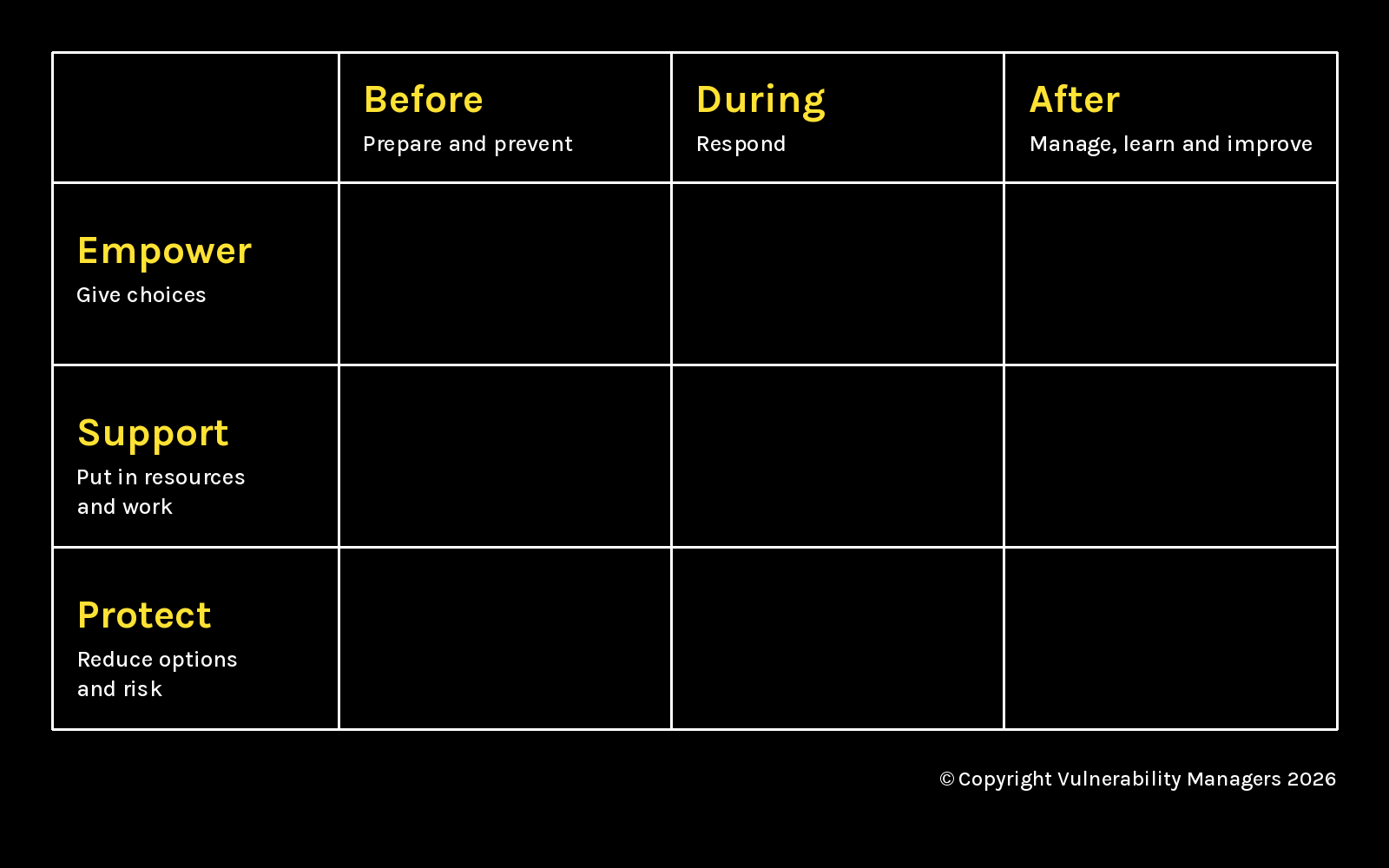
Put the two frameworks together: The 9 boxes
Cross the three stages with the three actions. You get nine boxes.
We base our work on the idea that to manage vulnerability well, you have to manage all nine areas.
If you cannot explain what you have in place to manage any one area, it is extremely likely you will have issue in that area that risks creating harm or disadvantage.
Our frameworks, our research
Our Director, Matt Radford, developed the Before, During, After model. It was first used in 2012 and has since been used by regulators, professional bodies, companies and charities across the world.
The frameworks are our intellectual property. That means we made them and we hold the rights to them. This covers the models, the grid, the wording and our tools. Vulnerability Managers Limited owns the copyright.
What you may do
You may name the frameworks. You may link to this page. Please credit Vulnerability Managers when you do.
What needs our permission
Ask us first if you want to copy them or teach them. Ask us first if you want to sell work built on them. We are glad to talk about a licence.